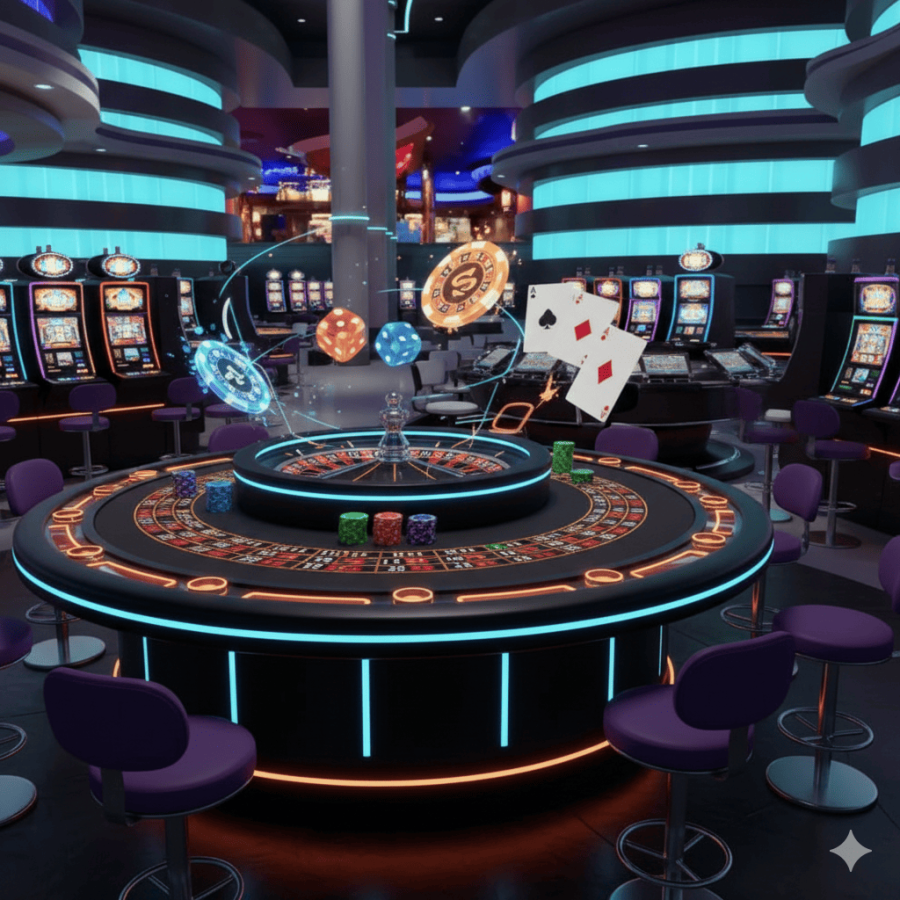
When I first explored the potential of AR casino games, I realized that we were standing at the edge of a revolution in online gambling, one that would blur the boundary between the physical world and virtual entertainment. From my perspective as an insider working in online casinos, AR offers not just a visual overlay or a novelty; it promises to fundamentally change how players engage with games, social environments, and even the concept of a casino itself. Unlike virtual reality, which transports players entirely into an artificial world, augmented reality allows the casino to fold seamlessly into the player’s own environment, creating interactions that are simultaneously personal, immersive, and persistent.
The Concept of AR in Gambling
From Overlay to Integration
AR is more than a visual gimmick. In gambling, it enables:
- Integration of virtual gaming elements directly into real-world spaces
- Interactive overlays that respond to motion, environment, and context
- Dynamic interactions that transform tables, cards, and slots into tangible experiences in the player’s surroundings
From my operational viewpoint, the distinction between AR and VR is crucial: while VR isolates, AR integrates, and the potential for blending gameplay into daily life opens avenues for unprecedented engagement.
Historical Evolution
AR concepts emerged as experimental casino features in the late 2010s:
- Early AR card games projected onto physical tables using tablets or smartphones
- Limited graphics and interaction confined novelty to small-scale experiences
- AI algorithms were initially used only for basic personalization or reward tracking
Over the past decade, hardware advancements, AI integration, and software sophistication have converged to make AR casino games more immersive, intuitive, and socially interactive.
Technological Foundations of AR Casino Games
Hardware and Sensors
AR relies on a range of hardware innovations:
- Smartphones and tablets with high-resolution cameras and motion sensors
- AR glasses and wearable devices for more immersive overlay experiences
- Depth sensors, LiDAR, and spatial mapping to detect and interpret real-world surfaces
From my operational perspective, hardware readiness directly impacts session quality, immersion, and play duration. Accessibility and comfort are as critical as visual fidelity.
Software Architecture
AR casino games require complex software systems:
- Spatial mapping engines to integrate virtual elements accurately into real-world environments
- AI-driven object recognition to interact with player gestures, tables, or even room layouts
- Real-time rendering and physics engines to maintain realism and responsiveness
Operationally, this complexity requires continuous optimization to ensure a seamless blend of virtual and physical elements.
AI Integration
AI enhances AR casino games in multiple ways:
- Predicting player behavior to adapt challenges or bonuses in real time
- Personalizing virtual dealer interactions and game difficulty
- Monitoring engagement patterns, session length, and emotional responses to optimize gameplay
From my experience, AI is not an accessory but the backbone of effective AR integration, allowing real-world environments to dynamically respond to players.
Gameplay Experience and Interaction
Blending Digital and Physical Worlds
AR allows casinos to overlay gameplay onto any environment:
- Virtual roulette wheels can appear on kitchen tables or office desks
- Slot machines may project directly into living rooms, allowing players to spin reels with natural gestures
- Cards, chips, and dealer avatars respond to spatial cues, creating a sense of presence without isolation
From my operational perspective, this integration dramatically enhances engagement while reducing friction between real-life and gaming experiences.
Social Dynamics in AR
AR casino games create new social interaction models:
- Players can invite friends into shared AR spaces for collaborative or competitive play
- AI-driven avatars can mediate multiplayer tables in real time
- Public spaces could become semi-private social casinos with AR overlays visible through devices
Operationally, these social features have the potential to increase session time, player retention, and monetization by embedding social reinforcement into gameplay.
Emotional and Cognitive Engagement
AR changes how players perceive risk and reward:
- Wins and losses feel immediate, tangible, and spatially grounded
- Environmental cues such as sound, visual feedback, and haptics intensify emotional response
- AI can detect frustration, excitement, or fatigue and adapt gameplay to maintain engagement
From my perspective, the psychological implications are profound, requiring careful calibration to maintain responsible gaming standards.
Challenges to AR Casino Mainstream Adoption
Hardware Accessibility and Cost
Despite improvements, AR requires investment:
- High-end AR glasses remain expensive for the average player
- Smartphones and tablets may limit experience fidelity, constraining widespread adoption
- Accessories such as haptic feedback gloves or wearable sensors increase cost and complexity
Operationally, cost and accessibility are significant barriers for mass adoption, especially when competing with conventional online casino interfaces.
Spatial and Environmental Constraints
AR depends on accurate environmental detection:
- Cluttered or confined spaces can interfere with projections
- Lighting conditions affect tracking and rendering accuracy
- Players may face safety concerns if gestural interactions require large or active movements
From my insider view, designing AR experiences that adapt fluidly to diverse environments is a key technical challenge.
Regulatory and Legal Considerations
AR introduces new regulatory dimensions:
- Age verification must apply to physical spaces and devices
- Anti-fraud systems must adapt to persistent, location-sensitive gameplay
- Responsible gambling monitoring must integrate with real-world behavior, not just virtual interactions
Operationally, regulatory adaptation is critical, as AR blurs conventional boundaries between personal, public, and digital spaces.
Opportunities and Advantages
Enhanced Player Engagement
AR allows deeper immersion without isolation:
- Players interact naturally with their environment, increasing realism
- Real-time AI feedback personalizes rewards, bonuses, and game difficulty
- Engagement is reinforced by the novelty and seamless integration of digital and physical spaces
From my perspective, this is the most compelling advantage: AR embeds gambling into everyday life, making the experience continuous, adaptive, and emotionally resonant.
Social and Community Building
AR casinos foster community:
- Multiplayer tables and shared AR experiences increase social interaction
- Collaborative games, tournaments, and competitive leagues are possible in real-world environments
- Shared experiences create virality and organic growth for platforms
Operationally, social embedding improves retention, monetization, and brand loyalty.
Innovation in Game Design
AR allows designers to create experiences impossible in conventional platforms:
- Spatial puzzles, mixed-reality slot adventures, and interactive dealer mini-games
- Gamification that incorporates real-world navigation, gestures, or environmental features
- Layered experiences combining real-world cues with AI-driven virtual elements
From my insider perspective, AR fundamentally expands the designer’s palette, blending spatial, social, and interactive mechanics.
Ethical and Responsible Gaming Considerations
Balancing Immersion and Safety
AR amplifies emotional and physical engagement, which requires vigilance:
- AI systems must detect overstimulation, fatigue, or risky betting patterns
- Environmental awareness alerts prevent physical hazards during gestural interaction
- Session monitoring ensures responsible engagement without breaking immersion
Operationally, this balance between engagement and safety is unique to AR platforms, requiring integrated monitoring systems.
Behavioral Analytics and Intervention
AR enables advanced behavioral tracking:
- AI monitors patterns in gestures, session length, and bet size
- Predictive interventions can prompt breaks or adjust difficulty before problematic behavior escalates
- Real-world context adds granularity to responsible gambling measures
From my perspective, AR provides unprecedented opportunities for proactive, context-aware interventions.
Transparency and Privacy
Data collection in AR must respect privacy:
- Spatial mapping, camera feeds, and behavioral analytics collect sensitive data
- Platforms must maintain strict data governance and compliance with privacy laws
- Transparency with players builds trust and encourages adoption
Operationally, privacy and transparency are non-negotiable for long-term success.
Market Considerations
Target Demographics and Early Adoption
AR appeals to specific segments:
- Younger, tech-savvy players and gamers are early adopters
- Socially-driven players seeking collaborative or competitive experiences
- Casual players may be slower to adopt due to cost, setup, or complexity
From my insider view, marketing and adoption strategies must align with demographic readiness and hardware penetration.
Economic Viability
AR casinos involve higher initial costs:
- Development of spatially mapped games and interactive AI systems
- Investment in hardware partnerships or subsidized devices
- Continuous updates to software and AI models for adaptive experiences
Operationally, ROI depends on engagement, retention, and monetization strategies that leverage the immersive, interactive nature of AR.
Competitive Differentiation
AR provides unique value propositions:
- Enhanced immersion differentiates from traditional online platforms
- AI-driven personalization and real-world integration create stickiness
- Social interaction layers increase loyalty and virality
From my perspective, early adopters can establish leadership in the AR gambling segment.
Future Trajectories
Mainstream Integration by 2026
AR casino adoption will accelerate with:
- Affordable, high-performance hardware and wearables
- Seamless software and AI integration for personalization and responsible play
- Regulatory frameworks adapted to augmented experiences
From my operational view, AR will complement, not replace, conventional platforms, creating hybrid ecosystems that enhance player choice.
Hybrid AR/VR Models
Future models will integrate AR and VR:
- Players can switch between immersive VR environments and AR overlays in real-world spaces
- AI ensures continuity of engagement, personalization, and rewards
- Hybrid models expand the audience by accommodating preferences, context, and convenience
Operationally, this flexibility maximizes accessibility and engagement.
Long-Term Societal Impact
AR casinos will redefine entertainment:
- Casinos may become semi-permanent overlays in homes, offices, or public spaces
- Persistent AI-driven interactions create dynamic, adaptive gameplay ecosystems
- Socialization, gamification, and mixed-reality events blur lines between leisure, gaming, and social engagement
From my perspective, AR is not merely a technology-it is a paradigm shift that transforms gambling from discrete sessions into continuous, context-aware experiences.
Final Perspective
From where I sit, AR casino games represent one of the most exciting evolutions in online gambling. Unlike VR, AR embeds gameplay into the player’s own environment, enhancing immersion, social interaction, and emotional engagement without isolation. Challenges remain in hardware accessibility, spatial constraints, safety, and regulatory adaptation, but the opportunities-dynamic game design, personalized AI interactions, and socially embedded experiences-are enormous.
In my insider view, AR casinos are poised to move beyond niche novelty, gradually becoming a mainstream option for players who value immersive, adaptive, and socially engaging gambling. By 2026, the integration of AR, AI, and responsible gambling systems will redefine the very notion of what an online casino can be, blending the virtual and real worlds into a seamless, interactive, and ethically responsible ecosystem that elevates both entertainment and engagement to unprecedented levels.
